Thursday, September 20, 2012

Scavenger Hunt

Illuminance:


6 fc

14 fc

25 fc
37 fc

47 fc
54 fc

65 fc

160 fc
 
Reflectance:

9%

25%

50%

78%
 
95%
 
Transmitance:
 
7%

36%
 
47%

73%

92%


Thursday, August 30, 2012

Windows as the Vessels to the Soul


Windows as the (natural light) Vessels to the Soul


                In comparing the contrasting styles of window types between the Japanese and Dutch culture, I hope to shed light on my own feelings towards window types and natural light based on what I had in my home growing up and my personal preference now.

                In the Japanese culture, houses have distinctive paper-covered windows called shoji.  They transmit a soft, muted light and don’t allow a street side audience to see anything more than a silhouette of what might be inside.  These types of windows embody the Japanese culture in that traditionally they are a more withdrawn and private society.

                In the Netherlands, windows are large and portals into the life of the Dutch.  They often are set up in a “shotgun” style, so from the street, one is able to see through the front window, into the living area, and right out the back window into the garden.  The Dutch people are proud of their possessions and like to showcase them, allowing natural sunlight to create focal points on different areas at different times of the year.

                In my house growing up, we had two extremely large picture windows in the living room.  They were set up in the same way the Dutch often set up their windows, in the shotgun style.  During the day, this was fine, because you could see anyone coming and going, and they let a tremendous amount of light into the room, despite the fact that our front yard was covered in pine trees and the back window was covered by a huge awning.  During the nighttime, however, the windows made me feel uncomfortable because I couldn’t see out and everyone could see in.  My dad used to say that we were like “fish in a fishbowl” at night, and insisted that the shades be drawn.  After high school, I moved to Los Angeles.  In the condo that I lived in I had floor to ceiling windows on the entire east wall.  They were the only windows that let in natural light in the whole apartment.  My level of comfort was higher because the condo was on the fifth floor and overlooked the city.  Anyone walking down the street couldn’t really see in, and at night the lights of the city were illuminated.  Unlike my home in Ohio, the vastness of the dark of night didn’t seem as overbearing.  I think that these two types of windows describes me as a person in that while I am an open person allowing people to see into my life, I am careful about people I don’t know intruding on my privacy.


Human Health and Light


                I found the articles and health and light very interesting.  I have known for awhile that natural light effects our sleep pattern, and people that work nightshifts in bright areas have a skewed sense of time.  For me, as soon as it gets dark I start to feel sleepy, and if a professor were to turn off the lights in a classroom, I almost immediately put my head down.  I took an art history class at night once.  It was a three hour class that went from 6-9.  In the darkened auditorium with plush seating, by 7:30 I had to be woken up.  Needless to say, I am taking non-western art history again. 

                I would like to see more studies about the effect of blue light (for example, the LEDs in computer screens) in relationship to our ever faster-paced society.  People are sleeping less and working more and I am curious to know if the type of light we are receiving is more than just a coincidence.  I am also interested in knowing if I can use this to my advantage:  for example, when studying or when I have to stay up late doing (iarc) homework, should I surround myself with computer screens and cfls?  I am also curious to know how different types of lighting affect people in jail.  With minimal natural light and nearly 24 hour artificial light, does this make them more or less aggressive and how does the pattern of sleep play into that? 

Tuesday, June 5, 2012

Linear sculptures!

Here are a few artists that have created some amazing linear sculptures.

Stacie Tamaki creates horse sculptures using a single piece of twine (or wire).  Her sculptures are much like the horses created by the artist who is features at the witherspoon museum.  I love the sketchy quality of the horse.  It creates the idea of movement by emphasising the idea of horse structure.

stacie tamaki
Michael Todd is a cross discipline artist that creates using wood, bronze, clay and paint.  His influences include primitive African sculpture and Japanese zen.  I really enjoy his use of balance in his pieces.  His bronze piece, Jazz, I think is aptly titled.  The use of shape and balance in his wood piece below really characterize the Japanese influence.

michael todd, jazz vii, bronze

michael todd, MCT 1010038, wood
Andy Goldsworthy likes to emphasis the relationship between man and nature by creating and documenting sculptures in nature that the elements will soon "destroy".  He collects things native to an area, like sticks, stones, or flowers, and arranges them in a way that is not normally found in the natural world.

andy goldsworthy, framing lake

David Lee Brown is a linear sculptor who utilizes steel tubing.  The sculpture below is outside the Fort Lauderdale Airport and right down the street from my old house in Florida.  He has twisted his linear configuration to give it flight, and the materiality of the piece makes the use of reflected and refracted light an important element.  I always wondered how the piece was kept so shiny, given it's proximity to the ocean.

david lee brown, steel

david lee brown, steel

Naum Gabo has made the piece below using a curved perspex frame and nylon string.  He is considered to a constructivist artist because the form follows a social commentary.  This piece reminds me of the theory of universal expansion, because it seems like it could continue to grow and still maintain it's form.  Although the nylon strings all connect in the center, none of them appear tangled.  Each string is purposeful and maintains a distinct function.

naum gabo, linear construction in space no. 2

Judd Turner is a working sculptor who sells many of his pieces as wall hangings.  I really liked the movement of the piece below, because it reminded me of the movement of water in a stream as it flowed around rocks.  When I saw the name of the piece I had to include it.

Judd Turner, stones in a stream, welded steel rod

Tea Petrovic is a conceptual artist who's influences include Naum Gabo.  She works with creating different types of high heels, but focuses on the form of the heal.  The rest of the shoe is based off her idea for the heel.  She does not include color in her work because she feels like it would detract from the overall conception of the form.

tea petrovic, plastic and wire
Aaron Kellner uses a vast understanding of cross disciplines to come up with inspiration for his puzzle-like pieces.  He enjoys the sciences - physics, chemistry, and biology and uses those ideas in his building block sculptures.  He also uses balance, proportion, symmetry and scale to define connections between space and form.

aaron kellner

And finally, one of my favorite sculptures, claes oldenburg.  He definitely does not practice in strictly linear terms, but his sculptures always make me laugh.  Scale is the most important part of his pieces.

claes oldenburg, free stamp, cleveland, ohio


claes oldenburg

claes oldenburg

Monday, April 16, 2012

Deconstructing upholstered chair

I've learned that taking out staples is a lot more difficult and time consuming than I thought!  No wonder people charge so much to reupholster!

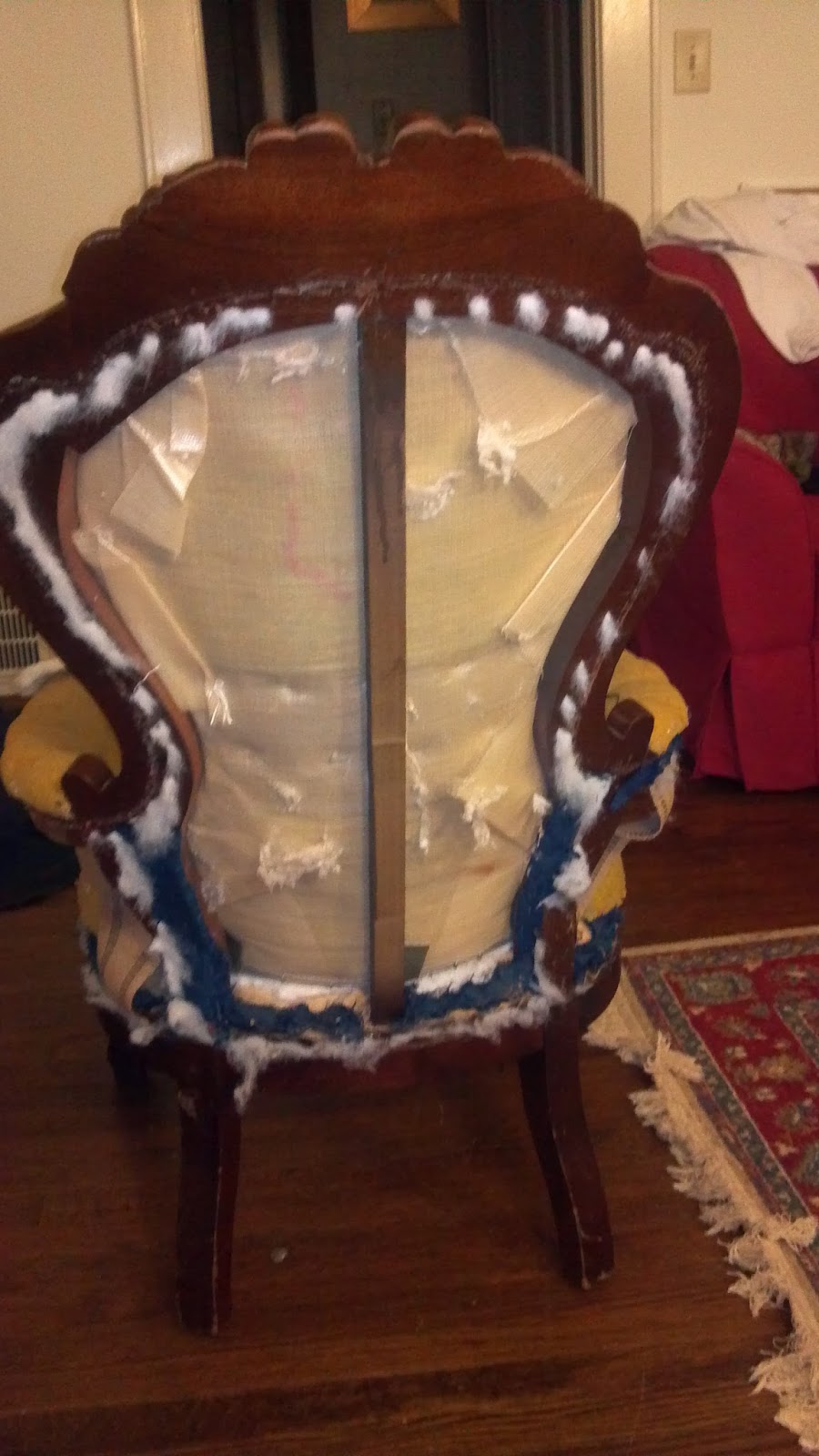
Last night I finally got the last pieces of fabric off the chair.  I only managed to cut or stab myself 3 times.  In diving into a large upholstery project, there are a few tips I've discovered along the way. 

First, there is an order of operations for removing the old upholstery fabric.  For a chair that has fabric on the front and on the back, you'd want the remove the center back panel first.  This will also be the last panel of fabric that goes on to the finished chair.  It's important to remove all the staples.  Instinctively, you would start at the top and work your way down, which is fine, but it will actually be easier if you remove the bottom row of staples first.  If you wait to remove the bottom row last, all the fabric will be flopping all over the place and getting in your way.  After you get a good handful of staples removed, you will be able to pull the fabric, but mostly likely the staples will remain in place.  Pulling on the fabric in some instances does help to loosen the staples, but you want to make sure not to rip the fabric because you will be using it as a pattern later on.


After the outer back and the outer sides have been removed, you can start working on the inner sides and back.  For the chair that I was working on, there were a lot of tufts and buttons, so I had to remove the cushioning on the back and on the sides (on the outside of the chair) in order to cut the knots that were holding the buttons in.  You could, I suppose, cut the buttons off from the front side, but if you were to be re tufting when you reupholster than you'd have to remove the batting from the back anyways when you tie the new buttons in.


When you start removing the fabric from the arms of the chairs, it can get pretty disgusting, especially where the fabric from the arms is stapled to the fabric of the seat cushion.  At this point I would definitely recommend having a vacuum on hand, and you may want to consider wearing rubber gloves.  Just to get some perspective, I found about a dollar worth of change, a cereal bowl worth of old Cheerios, pretzels and hardened cheese, a half a cat worth of fur, and an old fishhook. 


After I removed all the fabric and staples from the chair, it was time to remove all the hot glue remnants from where the previous owner (or upholsterer?) had hot glued all the welting to the junction of the fabric and the wood.  I choose to sand the hot glue off because I was going to be painting the chair anyway.  This would also be a fine way to go if you were going to refinish the furniture.  If you were trying to avoid painting or refinishing, I would carefully remove any glue or fabric remnants with pliers.  You'd also want to be careful when removing the staples because it's very easy to get a row on indented lines from the staples remover all along the edge of the wood.

Tuesday, April 10, 2012

Upholstery Project

My first piece was a dining chair.  I had a Thonet Bistro chair upholstered in this hideously decaying emerald vinyl.  After taking apart the seat and removing the vinyl, I embarked on the project of sanding off all the old stain and varnish.  I thought that part of the project would go pretty quick, but as it turned out, it was the longest part!  I'm quite familiar with sanding on flat surfaces, but I've never had the opportunity to sand bentwood, will all it's curves and grooves.  When the sanding was completed, I stained it with minwax stain/poly in one.  I ended up putting two coats on and it came out great!

For the seat, I choose an upholstery fabric that I had gotten from my mom a while back.  She had gotten it from a friend's mother, and based on it's color and pattern, I'd say it was from the 60's.  It's a really awesome limey-green velvet flower pattern.  I had to take a deep breath before I started cutting it up, but now that it's on my refinished Thonet chair I feel excited that I finally got to use it.  (I still have some left!)
Reupholstered Thonet Chair, with scale figure (Romeo)

I have 1-2 ottomans that I'm working on, while simultaneously working on "the big chair".  It's a little bit more complicated than what I originally anticipated, but I think it will look really cool in the end.  I'm not going to try to deal with all the sanding of all the intricate parts.  Instead I'm going to hit a few spots with the orbital, then spray the whole thing white.  I'll go back over it with a fine sandpaper in a few spots, then hit it with a stain to get the "dirty" look.  I learned this technique when we went to our Sherwin Williams field trip, and I think it will be a lot more time efficient.

The "big chair"
Back of the "big chair"
I ordered my supplies from Amazon.com yesterday so they should be in towards the end of the week.  I had a really tough time picking out fabrics because there were a lot of them that I really liked.  Because of the tufting and the grooves in the foam, I had to pick a fabric that wouldn't look odd when part of the pattern cuts off.  I envisioned the fabric to look a little bit more on the modern side, to juxtapose with the style of the chair. 

Fabric swatch of upholstery fabric

Wednesday, April 4, 2012

My Fabric!

My fabric came in yesterday!  I love it.  I especially love the upholstery sample I made.  I'm going to order 2 yards of it and reupholster an ottoman with it.  It was especially designed to go with upholstery pieces that are tufted - that is, buttons and pleating.  The pattern repeat on the upholstery fabric creates a circle where the botton will go.

Upholstery Sample

Kona Cotton
Closeup of Kona Cotton Design

Recycled-Parts Furniture

Doing my upholstery project in Studio has inspired me to rekindle my love of furniture.  I especially love the eclectic pieces, made from up-cycled materials.  I'm starting a collection of my favorite pieces on my blog, so I'll post them as I run across them. 
Here's one I found today, from Dornob.com.

These interesting pieces are made from scrap wood and melted tin that was found locally (local to the artist).  He cut the wood to make a uniform shape then melted the tin around the pieces to hold them into place.  You can find more of this designer's work at his web pagehttp://www.pepeheykoop.nl/.

Thursday, March 22, 2012

Rendered Library Perspective

I enjoy how quickly you can see progress from a blocky, non-realistic looking space to a space that one might actually be able to use!!  I'm still working on a few details - I'd like to add some ontourage (like books on the shelves) and play with the lighting some more. 
Not bad for a first draft!

Rendered Perspective

Gatewood Studio's Library and Conference Room - Animated Fly-Through from SketchUp

First Draft of my animated fly-through!